Low-temperature flow improver for biodiesel fuel"NEOPROVER"
Improved flowability of biodiesel fuel!
Can be used in colder regions
New “NEOPROVER” Cold FlowImprover Under Development, Optimized for Hydrotreated Vegetable Oil
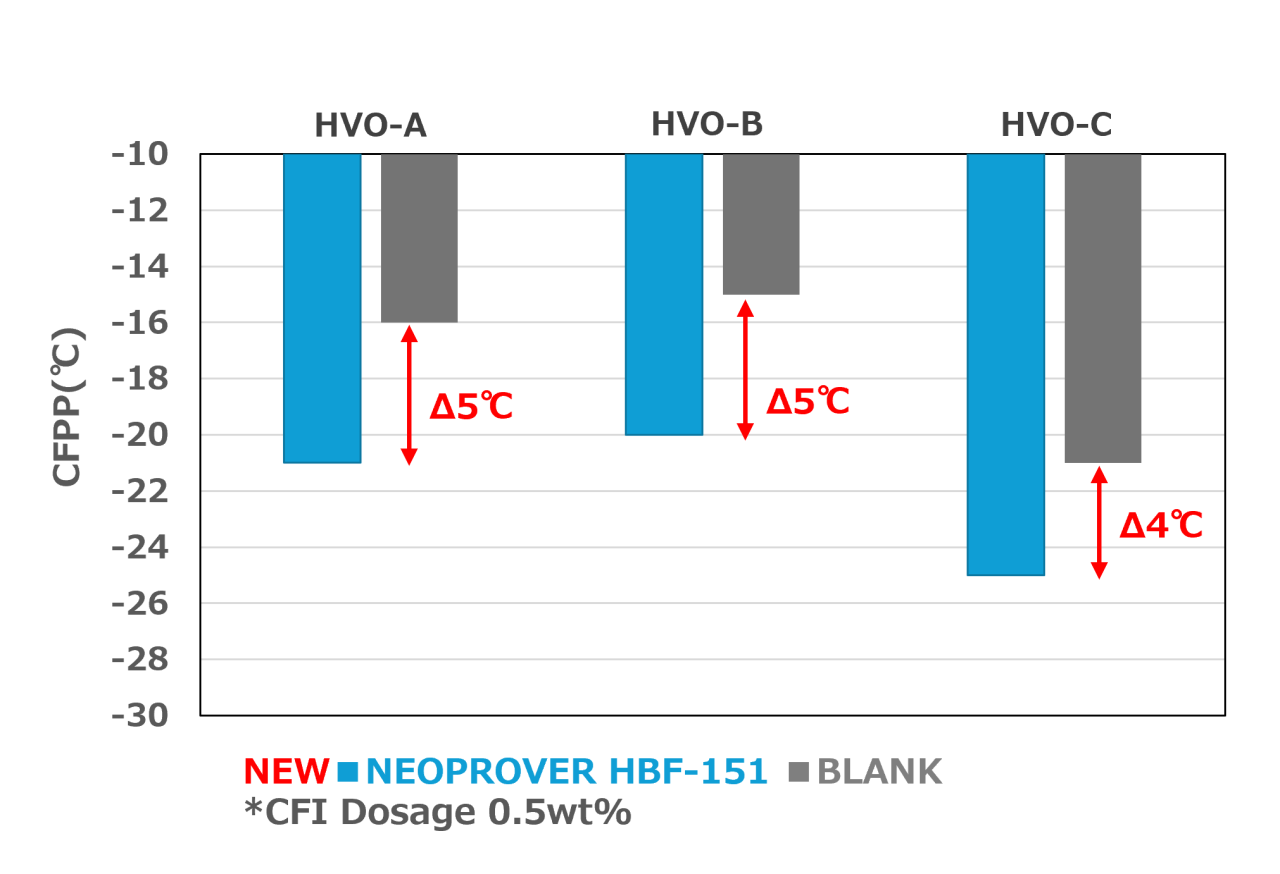
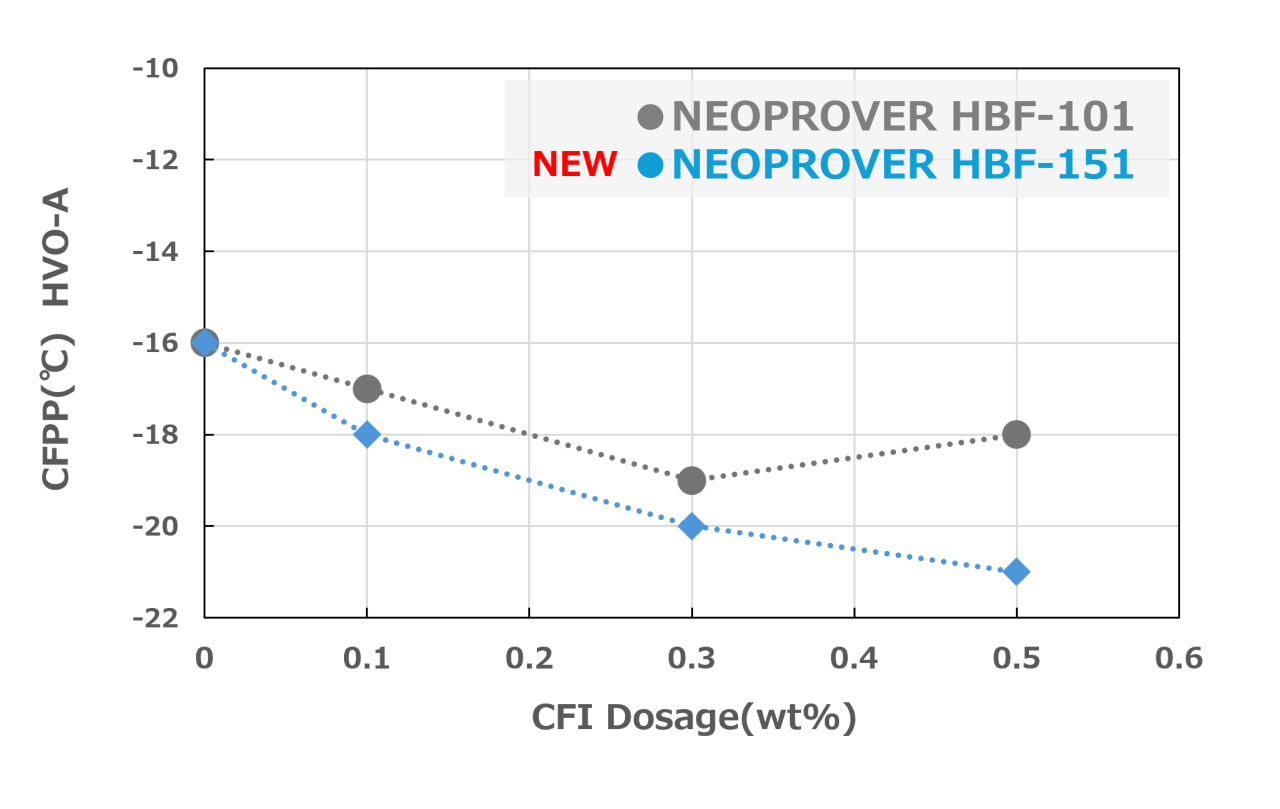
NEOPROVER HBF-151 has been addes to the "NEOPROVER" series of cold flow improvers for biodiesel fuels as a new product under development optimized for hydrotreated vegetable oil(HVO). HBF-151 was designed with a focus on the unique low-temperature properties and crystallization behavior of HVO, which consists of paraffinic hydrocarbons. Excellent cold flow improvement capabilities has been across various types of HVO.
What Are Biodiesel and Renewable Diesel?
Biodiesel and renewable diesel are renewable fuel dor diesel engines pruduced from feedstocks such as soybean oil, palm oil, coconut oil, and uded cooking oil(UCO). Like fossil diesel, these fuel emit CO2 during combustion, but the CO2 emitted during use is offset by the CO2 absorbed during the growth of the biomass used as feedstocks. As the result, the biogenic CO2 emissions from combustion can be regarded as carbon-neutral, while lifecycle greenhouse gas emissions can be significantly reduced compared with conventional fossil diesel.
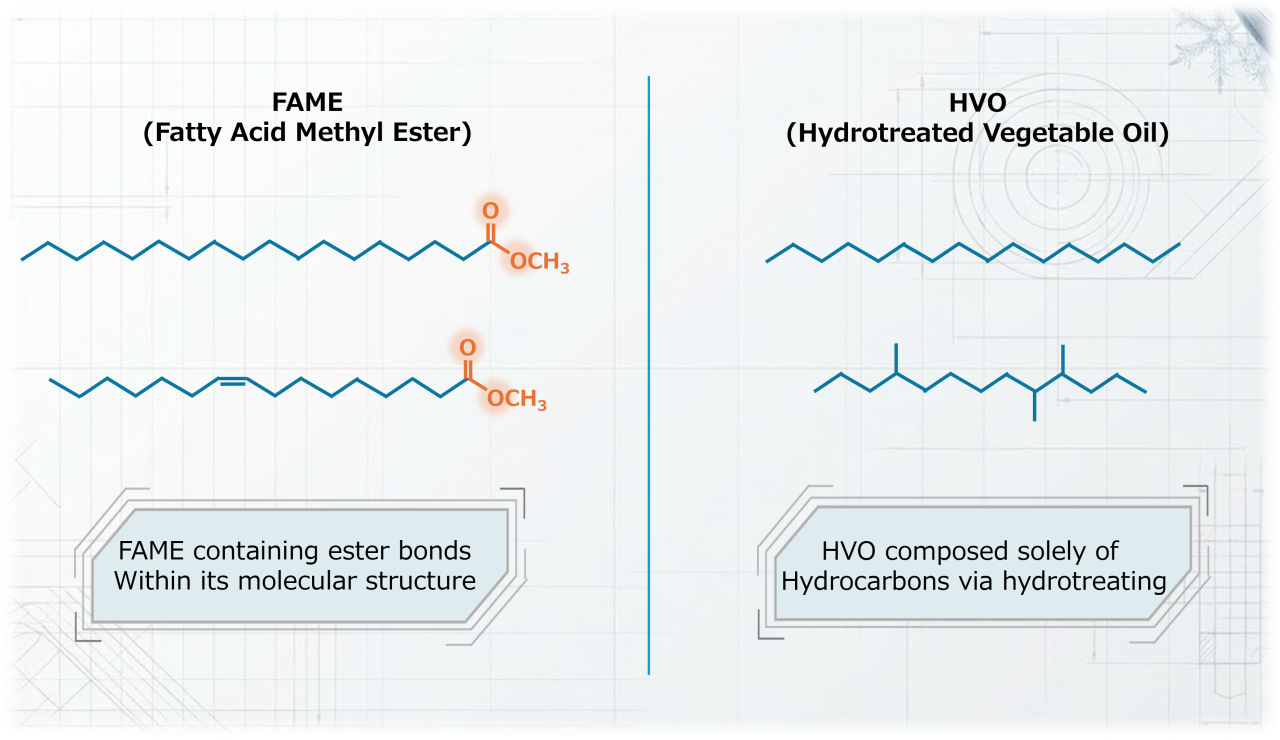
Two major types of reneable fuels for diesel engines are fatty acid methyl ester(FAME) and hydrotreated vegetable oil(HVO). HVO has properties similar to those of conventional diesel fuel and is also commonly referred to as renewable diesel(RD). FAME and HVO have different chemical structures, which result in different crystallization behavior and cold-flow properties. The figure beolow shows schematic representations of their structures.
Challenges When Using Biodiesel and Renewable Diesel at Low Temperatures
When biodiesel or renewable diesel is used in winter or cold climates, components in the fuel can crystallize, reducing fuel fluidity and posing a risk of plugging filters and pumps. Therefore, improving low-temperature flowability is essential for stable use in cold regions.
The crystallization mechanisms of FAME and HVO differ. In FAME, components derived from fatty acid methyl esters crystallize at low temperatures, leading to a loss of fluidity. This behavior varies significantly depending on the fatty acid composition of the raw oil feedstocks (e.g., UCO*, soybean oil, palm oil), and FAME generally tends to have inferior low-temperature flowability compared to conventional diesel fuel.
On the other hand, while HVO possesses low-temperature characteristics similar to conventional diesel fuel, it exhibits a different crystallization behavior from FAME because it consists mainly of paraffinic hydrocarbons. For this reason, improving low-temperature flowability requires additives tailored specifically to the characteristics of HVO.
*UCO = Used Cooking Oil
Reduction of cold filter plugging point (CFPP) by low-temperature flow improver for biodiesel fuel "NEOPROVER"
The Cold Filter Plugging Point (CFPP) is an index that evaluates the fluidity and freezing point of fuel.
Adding “NEOPROVER” to biodiesel fuel has the effect of lowering the plugging point of the fuel by 2~4℃, contributing to the use of biodiesel fuel in cold climates.
Test Conditions
CFPP: In accordance with JIS K 2289.
What's Great about Sanyo Chemical's Low-Temperature Fluidity Improver for Biodiesel Fuel "NEOPROVER"
1
Reduced fuel cold filter plugging point (CFPP)
"NEOPROVER" shows excellent low-temperature flowability enhancement performance for biodiesel fuels and is effective in lowering the Cold Filter Plugging Point (CFPP) of biodiesel fuels.
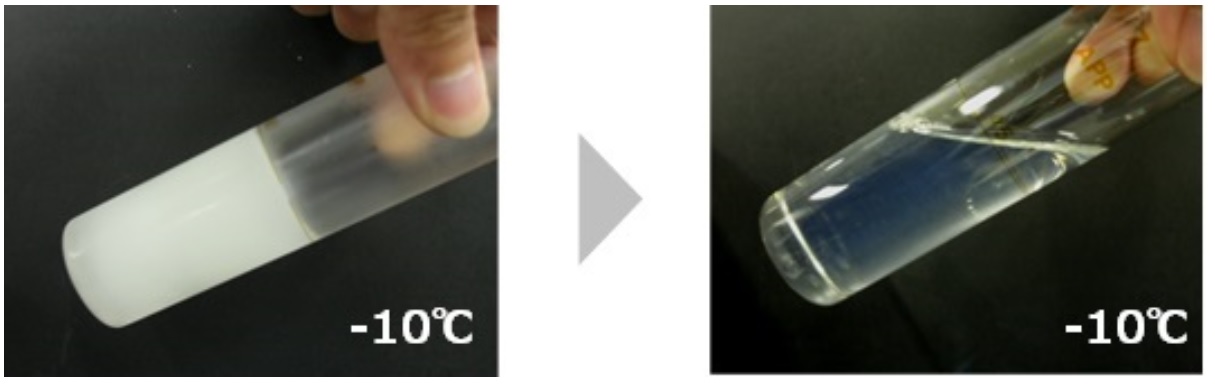
Fig. Effect of adding "NEOPROVER" to biodiesel fuel to improve low-temperature flowability
2
Compatible with various biodiesel fuels
“NEOPROVER” is effective on a wide variety of biodiesel and renewable diesel fuels. For FAME, its effectiveness has been confirmed across fuels derived from different raw oil feedstocks, such as soy, palm ,coconut, and UCO. Furthermore, by adding this new developmental product designed for HVO, we have expanded our range of applications.
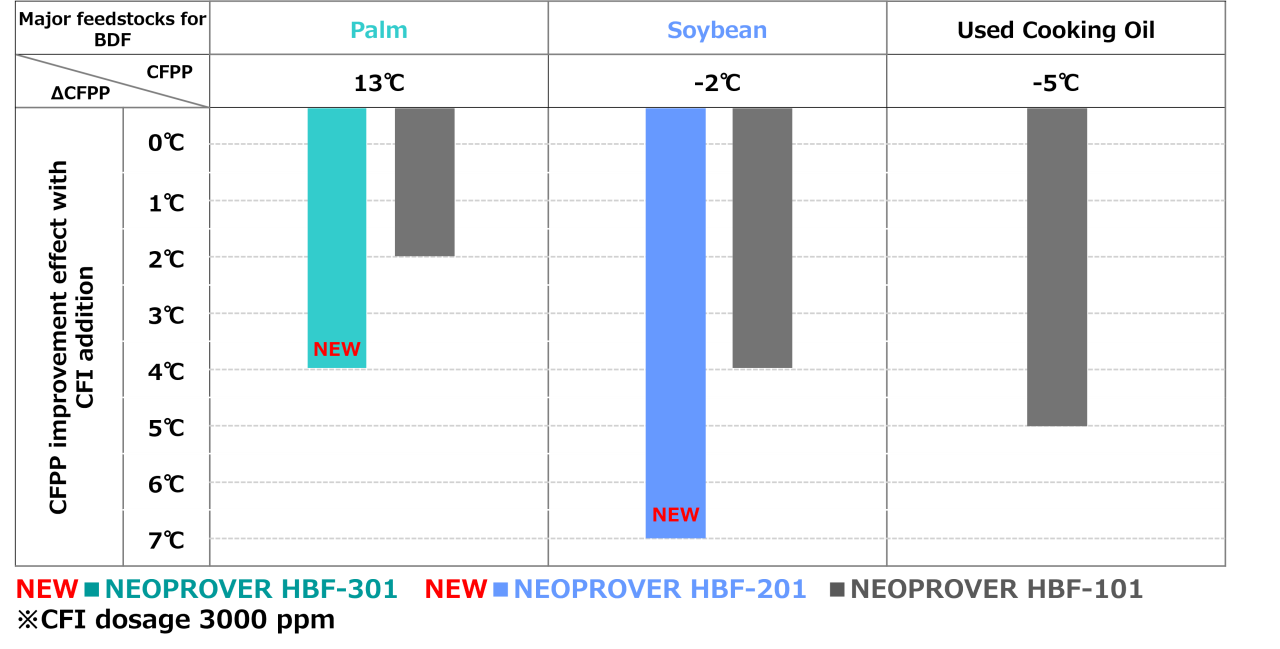
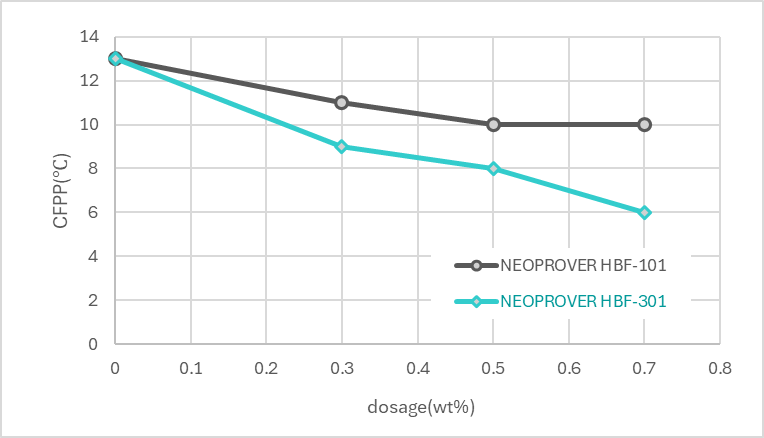
Fig. Effect of NEOPROVER HBF-301 on biodiesel Fuel from Palm

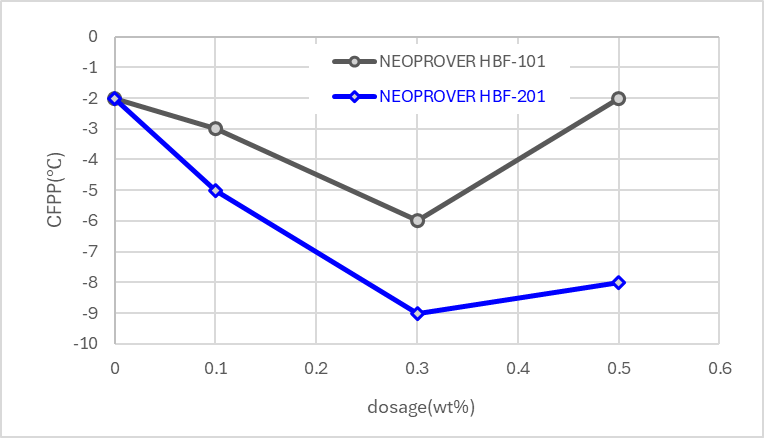
Fig. Effect of NEOPROVER HBF-201 on biodiesel Fuel from Soybean
Effect of Adding “NEOPROVER HBF-101" to Japanese Biodiesel Fuel (FAME)
“NEOPROVER” works well with a variety of biodiesel fuels.
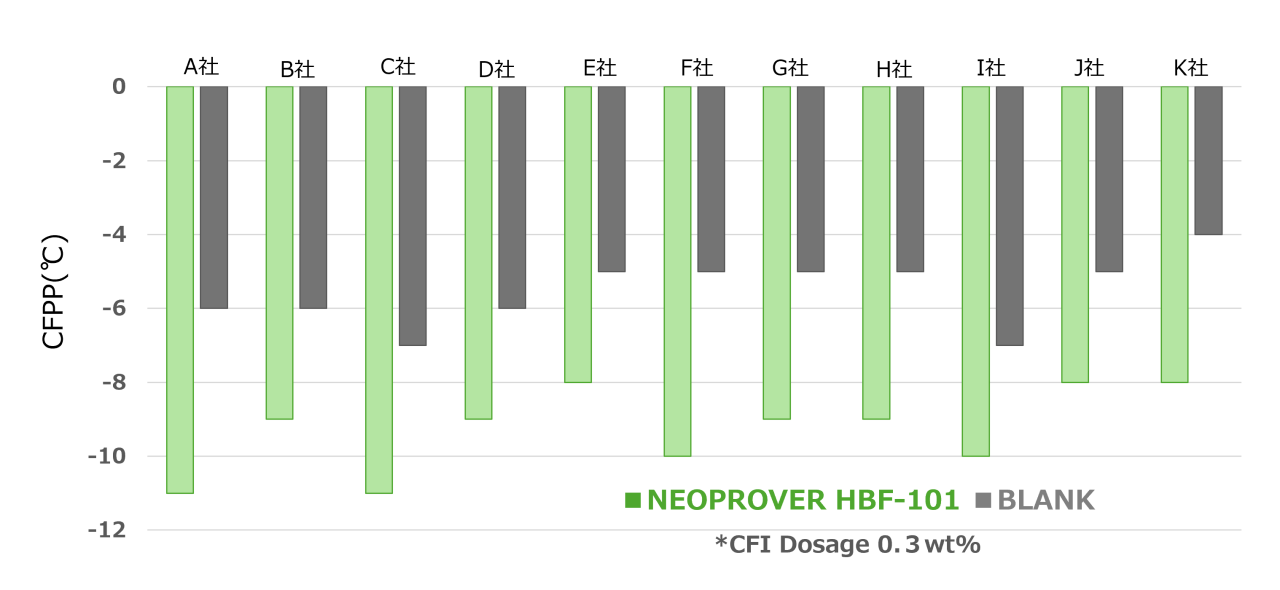
Fig. Effect of adding “NEOPROVER” HBF-101 to domestic biodiesel fuel (FAME)
Main properties of "NEOPROVER" Cold Flow Improvers
NEOPROVER | NEOPROVER | NEOPROVER HBF-301 (products under development) | NEOPROVER HBF-151 (products under development) | Remarks | |
|---|---|---|---|---|---|
| Taget Fuel | FAME(UCO) | FAME(Soy) | FAME(Palm) | HVO | N/A |
| Apprearance | Pale yellow to yellow liquid | N/A | |||
| Density | 0.91 g/cm3 | 0.91 g/cm3 | 0.90 g/cm3 | 0.90 g/cm3 | 15℃、JIS K 2249 |
| Kinematic viscosity | 165 mm2/s | 60 mm2/s | 60 mm2/s | 64 mm2/s | 100℃、JIS K 2283 |
Representative values are listed.
Regarding our products under development(HBF-201, HBF-301, and HBF-151), we are currentyl evaluating their parformance and application conditions at the labolatory level. We are expanding the "NEOPROVER" series to provide a broader range of cold flow improvers tailored to the specific types and charactaristics of biodiesel and renewable diesel fuels. If you are seeking solutions for winther and cold-climate applications of biodiesel or renewable diesel, or if you would like to request and evaluate samples of our products under development, please feel free to contact us.
Related Information
Related products
- Links to Sanyo Chemical's corporate site
This page has been prepared solely for information purposes.
Sanyo Chemical Industries, Ltd. extends no warranties and makes no representations as to the accuracy or completeness of the information contained herein, and assumes no responsibility regarding the suitability of this information for any intended purposes or for any consequences of using this information.
Any product information in this brochure is without obligation and commitment, and is subject to change at any time without prior notice.
Consequently anyone acting on information contained in this brochure does so entirely at his/her own risk.In particular, final determination of suitability of any material described in this brochure, including patent liability for intended applications, is the sole responsibility of the user. Such materials may present unknown health hazards and should be used with caution. Although certain hazards may be described in this brochure, Sanyo Chemical Industries, Ltd. cannot guarantee that these are the only hazards that exist.